

 By Admin
 November 13, 2026
Hot dip galvanizing is a popular way of protecting steel components. By covering them in a layer of zinc. This is commonly done for items such as transmission towers, pipes, poles, gratings, cable trays and other fabricated items. To ensure efficiency when setting up your galvanizing facility you will need to plan the preparation, chemical treatments, rinsing, fluxing, zinc coating and fume areas.
At Plast World we supply thermoplastic process tanks and ancillary equipment for your metal finishing and hot dip galvanizing requirements. As a Galvanizing Plant Manufacturer we specialise in process equipment, and can act as a Galvanizing Plant Supplier or a Galvanizing Plant Exporter to provide equipment for your project.
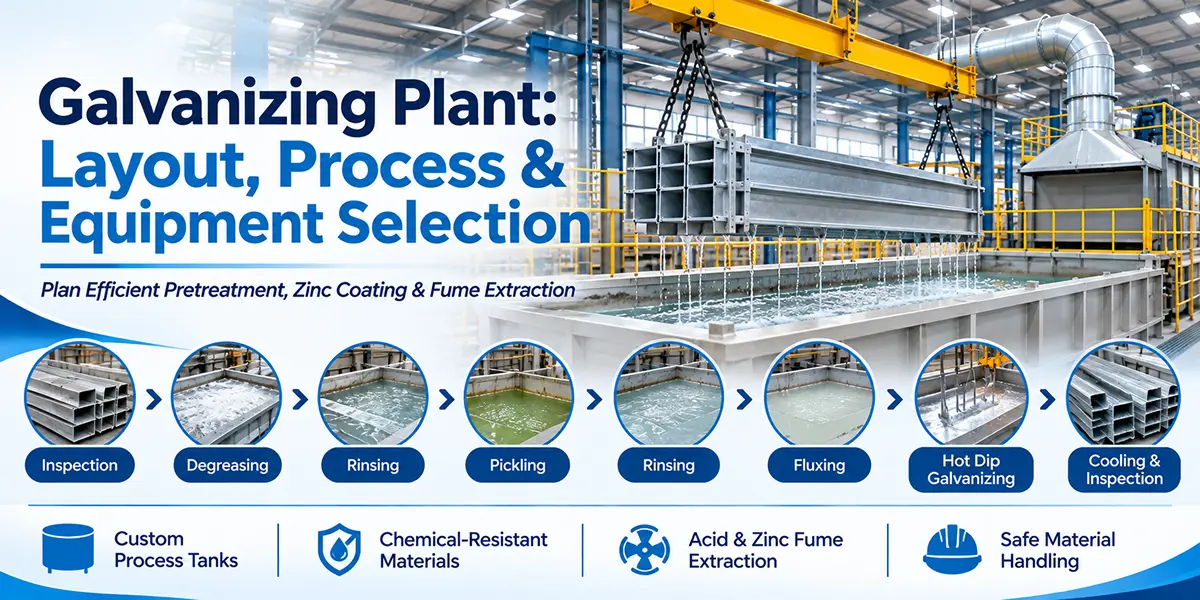
Galvanizing plants are used within industry to cover steel and iron components in molten zinc. This creates a protective layer. When designing your galvanizing plant layout you need to ensure the components will flow through your process. The layout will determine how your components will go through the process.
Having a good layout in place will keep the process flowing in a logical order, whilst also managing the chemicals, reducing any unnecessary movement and providing maintenance and safety.
Galvanizing plants are commonly used within industries to treat the following items:
The layout and specification of the galvanizing plant will depend on the size, weight, quantity and type of steel items.
Hot dip galvanizing works by dipping the correctly prepared steels into a bath of molten zinc. Before this, the steel needs to be cleaned.
Generally you will have the following:
At Plast World we can supply thermoplastic tanks for your pickling, degreasing, rinsing, fluxing and other pre and post treatments. We can also provide fume extraction equipment for relevant galvanizing applications.
Generally, your hot dip galvanizing plant will contain the following process. However this can vary depending on the product.
Some plants will also have passivating stages, drying stages and other pre or post treatment tanks.
Hot dip galvanizing and pickling processes can create fumes, mist and white smoke. These should be considered when planning your facility.
A good plan should include:
Plast World manufacture acid fume extraction systems and zinc white fume extraction systems to help manage fumes during your galvanizing process.
Consider the following:
When choosing your Galvanizing Plant Manufacturer you should ensure they can provide you with customizable equipment to suit your item size, chemical and production requirements. An experienced Galvanizing Plant Supplier and Galvanizing Plant Exporter should be able to understand your whole pre-treatment process and suggest the best tank and fume extraction setup.
Plast World specialize in supplying thermoplastic process equipment for your metal finishing and hot dip galvanizing needs. We have been established since 2004 and are based in Vatva, Ahmedabad, Gujarat. We can supply galvanizing, pickling, anodizing and electroplating industries.
We have a wide range of tanks to supply for your galvanizing requirements including galvanizing, pickling, acid storage, pretreatment, degreasing, rinsing, fluxing and fume extraction. We can also provide custom fabricated items.
We have a large manufacturing facility of approximately 75,000 sq. ft. We have in house design, manufacturing and quality control. We have quality checks in place and test for tensile, flexural, impact and compressive strengths.
We also have thermoplastic tanks with heating & circulation, flat pack modules for easier transport and assembly and fume extraction. We focus on understanding your process, chemical, item size and production to plan your setup.
By having a good plan for your galvanizing plant you will have the correct pre-treatment tanks, rinsing and fluxing, zinc coating, handling and fume extraction. Choosing the correct materials, size and ancillary items will allow you to have an organized process for different industrial applications.
At Plast World we supply thermoplastic process tanks and fume extraction for hot dip galvanizing and metal finishing industries. As a Galvanizing Plant Manufacturer we specialise in providing equipment for your specific project. If you are looking for a reliable Galvanizing Plant Exporter or Galvanizing Plant Supplier then please get in touch and we can discuss your tank size, material, process layout and fume requirements.
A typical hot dip galvanizing plant will have degreasing, rinsing, pickling, rinsing, fluxing, molten zinc coating, cooling and final inspection.
To remove rust, mill scale and oxides from your steel. This ensures your steel is prepared correctly for coating.
Industrial thermoplastics such as polypropylene. This will depend on the chemical solution, concentration and temperature.
Tank sizes will depend on the largest item, batch size, immersion requirements, process and space available.
During pickling and hot dip galvanizing you may have acid and zinc fumes. Having the correct extraction and scrubbing will help manage this.
Yes. Tank sizes, materials, construction and ancillary can be planned to suit your process, chemical, item sizes and production requirements.
Important information to know includes: Type and size of steel items, quantity of production, treatment process, chemical requirements, space available, tank requirements and fume requirements.

Plast World
Plot NO. 07, Dev Estate,
Nr. National Rifle, Opp. Power House,
Ramol Cross Road, Vatva,
Ahmedabad- 382 445
Gujarat (india)
Powered by : #1 Vinayak InfoSoft - SEO Company Ahmedabad All Copyrights © . Plast World
