

 By Admin
 November 11, 2026
Pickling is an important surface treatment process. Within this process it is important to have a tank that can handle the chemicals whilst providing a strong and reliable option. Selecting the correct material to build your pickling tank is key.
FRP (Fibre Reinforced Plastic) and PP (Polypropylene) tanks are commonly used within chemical processes. Both materials provide anti-corrosive properties; however the chemical concentration, working temperature, tank size and installation will affect suitability.
At Plast World we create thermoplastics process tanks and FRP tanks to support your industrial needs. As a well known FRP pickling tank manufacturer and PP Pickling Tank manufacturer; we can help you understand what tank setup would be suitable for your process.
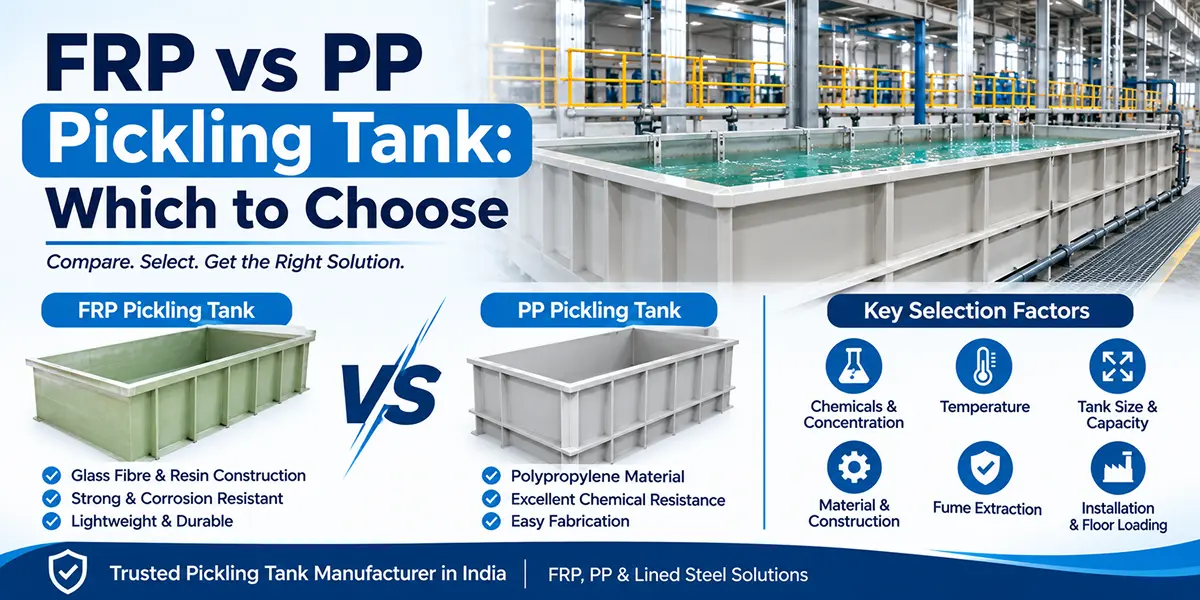
A pickling tank is used within industry to contain chemical solutions. They are commonly used within steel, galvanising, wire, pipe and finishing processes.
The main differences between FRP and PP tanks are based around the construction.
Apart from FRP and PP, lined steel tanks are another option for industrial chemical handling. The most suitable choice depends on the application rather than material preference alone.
Depending on the pickling process some tanks may have heating and circulation features. These should be included within your tank design.
Which is best?
Always consider the chemicals, temperature, tank size and installation when selecting the material.
One of the most important factors to consider when choosing a pickling tank is the chemical compatibility. A tank may work well with one acid but not another chemical or concentration.
FRP
FRP tanks can be made using a variety of resins for example polyester, vinyl ester and specialist resins. The acid, alkaline and solvent resistance will depend on the resin and laminate.
Before choosing an FRP tank, consider the following:
PP
Polypropylene can be used within a variety of chemical processes including pickling, degreasing, rinsing and plating. However the performance can depend on the chemical, concentration, temperature and load.
Consider the following:
Lined Steel
Lined steel tanks provide a strong tank with a chemical lining. The lining must be compatible with the chemical solution and temperature.
If the lining is damaged it could expose the steel causing corrosion and leaking issues. Regular inspections are important.
Choosing the right tank will not just be about price. Consider the full environment.
When choosing an FRP pickling tank manufacturer consider the resin, laminate, chemical compatibility and tank specs. When choosing an experienced p.p. pickling tank manufacturer they should be able to explain the grade of PP, welding, size, storage capacity and limitations.
We create thermoplastic process tanks and FRP tanks to help with chemical handling within your industry. We have been in business since 2004 and are based in Vatva, Ahmedabad, Gujarat. We can help galvanising, pickling, electroplating and other surface treatment industries.
We have a wide range of products including PP pickling tanks, FRP tanks, acid storage tanks, degreasing, rinsing, flux tanks and fume extraction. We can also create customised tanks to suit your chemical environment, component size and installation.
On our website we have PP tanks with Homopolymer and Copolymer materials. These have been fabricated using Hot Gas Extrusion welding and stress relieved. We also have flat pack tank modules to make them easier to transport. We have heating and circulation for certain applications.
We aim to understand the process requirements of our customers to advise on the best tank. This includes considering the chemical compatibility, temperature, tank size, support and fume extraction.
Depending on the chemicals, temperature, capacity and structural requirements you may want to choose FRP, PP or Lined Steel pickling tanks. FRP provides a reinforced laminate tank, PP provides a versatile thermoplastic tank and Lined Steel provides a strong tank with a chemical lining.
At Plast World we create process tanks to support your industry. We also have customised chemical handling solutions for various metal finishing applications. As an FRP pickling tank manufacturer we can provide tank options to suit your project. If you are looking for a p.p. pickling tank manufacturer we can help you with the size, material, storage capacity and suitable options for your pickling.
FRP tanks have glass fibre and resin. PP tanks are fabricated from polypropylene sheets. The anti corrosive properties, structural design and temperature suitability will depend on the material.
Both FRP and PP can be suitable for certain acid pickling applications. This depends on the type of acid, concentration, temperature, exposure time and tank design.
PP tanks can be used for certain Hydrochloric acid pickling. However compatibility should be confirmed with the acid concentration, temperature and application.
This depends on the size of the tank. On our website we have PP pickling tanks with capacities up to 100,000L.
Yes, the size, capacity, material and support can be customised to suit your process.
It is important to know the type of chemical, concentration, temperature, component size, capacity, duration and installation space. Any heating or fume extraction requirements.

Plast World
Plot NO. 07, Dev Estate,
Nr. National Rifle, Opp. Power House,
Ramol Cross Road, Vatva,
Ahmedabad- 382 445
Gujarat (india)
Powered by : #1 Vinayak InfoSoft - SEO Company Ahmedabad All Copyrights © . Plast World
