

 By Admin
 October 21, 2026
Hot dip galvanizing is a process that coats steel with molten zinc to prevent it from corroding. Structural steel, fabricated parts and fasteners are frequently used. However, dipping prepared steel into molten zinc can release visible fumes that must be managed carefully. Plast World industrial equipment solutions include those for galvanising operations.
The white fumes from a galvanizing kettle can impact visibility, cleanliness and air quality. Their source is related to process materials and operating conditions and should not be assumed, but calculated instead. A well-designed Zinc White Fume Extraction System will collect fumes at their point of generation and guide them to an appropriate treatment device. Plast World can assist companies in exploring options based on plant layout and process requirements.
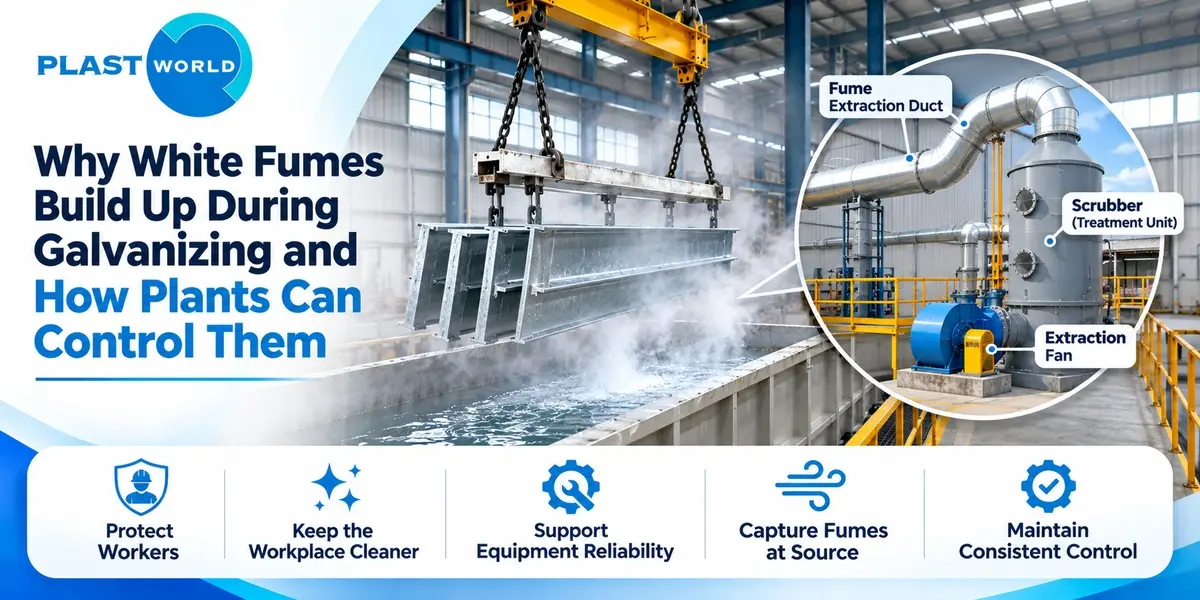
Emissions can result from process reactions and materials on the surface of the steel when it enters the molten zinc. Visible fumes may be affected by flux residues, moisture and operating conditions. Real emissions will vary with the chemicals, materials, temperature and equipment used. If the operator observes anything unusual, they should investigate.
1. Protecting Workers
Exposure risks can be posed from airborne contaminants. Emissions are captured near the kettle to minimize the dispersion of the emissions into work areas. The use of protective equipment, staff training and exposure assessment still play an essential role in a safety programme.
2. Keeping the Workplace Cleaner
Fumes may cause deposits in other structures and equipment if fumes are not controlled. Good capture and treatment will minimize contamination, make the work area more visible, and make it easier to maintain the area.
3. Supporting Equipment Reliability
Dust and dirt from emissions may impact the machinery, electrical equipment and construction of buildings. Correct extraction can ensure the protection of equipment, and avoid unnecessary cleaning or maintenance.
The standard arrangement is capture ducting that is placed close to the emission source. A fan sucks in the contaminated air and pushes the air toward a treatment unit. The system can be designed to be made up of a scrubber or other appropriate equipment prior to the release of air via a specified outlet.
Galvanizing fume extraction equipment can consist of a lip-type lateral ducting around the zinc kettle, a centrifugal fan and a scrubbing unit. The optimum combination will depend on the layout of the plant, the size of the kettle and the process parameters.
Fumes are sucked up around the edge of the kettle through the lip type lateral suction. It can be used in operations that require access for dipping and material handling. A full enclosure system will contain emissions before removing them from the system and could impact access and material movement.
Both are not necessarily the ideal choice for each facility. A design should be selected based on the size of the kettle, the travel of the crane, the production rate, available space and anticipated emissions. The objective is to effectively collect fumes without compromising safe production.
Check and clean the ducting, joints, fans, scrubbers, and other ducting components as per maintenance schedule. Examine any changes in air flow, smoke visible from the fume escape, odd sounds or deposits around capture points. Follow and adhere to treatment components as per supplier guidelines and as per relevant requirements.
Staff need to identify issues, report faults and practice safe procedures. If the system is not properly maintained, it might not collect the emissions as desired.
A Zinc White Fume Extraction System should be designed to match the size of the kettles, the quantity of production, handling practices, emission characteristics and the treatment required for the fumes. Look into space requirements, access for maintenance, energy consumption, and technical assistance. Inquire with suppliers about its suitability to the process and its regularity of checks. Relying on the price of the Zinc White Fume Extraction System is not sufficient to choose the right one for the plant; it should be evaluated according to the actual conditions of the plant.
Any fumes from galvanizing must be dealt with practically. Knowing where they come from, how to capture them, selecting the proper equipment, and proper maintenance can help to keep the workplace cleaner.
Visit Plast World to explore industrial galvanizing and fume extraction equipment. Contact the team to discuss your plant layout and identify a suitable control arrangement.
Reactions in the process and materials that may be introduced into the molten zinc bath are a source of emissions.
Emissions are managed through source capture, appropriate ducting, extraction fans and treatment equipment.
No. The system needs to be designed, operated, maintained and evaluated correctly with regard to applicable requirements.

Plast World
Plot NO. 07, Dev Estate,
Nr. National Rifle, Opp. Power House,
Ramol Cross Road, Vatva,
Ahmedabad- 382 445
Gujarat (india)
Powered by : #1 Vinayak InfoSoft - SEO Company Ahmedabad All Copyrights © . Plast World
