

 By Admin
  September 28, 2026
A clean wire surface is the starting point for many successful metal finishing processes. Before wire moves toward galvanizing, coating, plating, or other treatments, unwanted scale and oxides need to be removed. Pickling plays an important role in this stage, but the effectiveness of the process depends on more than the chemical solution alone. The tank holding and handling that solution also has a direct role in process reliability. Choosing the right pickling equipment can support consistent treatment, chemical resistance, and smoother production. Plast World provides thermoplastic process equipment for demanding metal treatment applications, including solutions for wire and coil pickling.
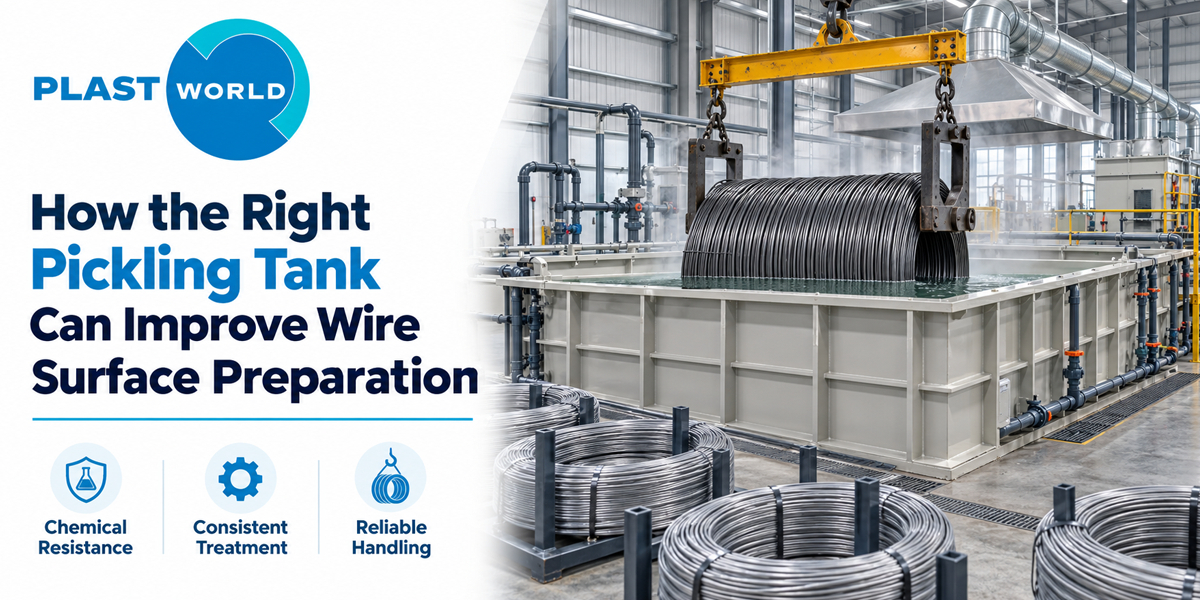
Industrial wire can carry mill scale, rust, oxides, and other surface deposits resulting from manufacturing, heating, storage, or handling. These layers can interfere with subsequent surface treatments if they are not properly removed.
The process of pickling involves dissolving surface layers with the help of an acidic solution. This leaves the clean surface behind which is better prepared for further processing. The goal here is not just to clean the wire visually. Surface preparation may affect the way of interaction between a finish and metal.
For wire manufacturers, achieving this preparation consistently is particularly important because surface variations can carry forward into later stages of production.
It is easy to think of a pickling tank simply as a vessel that holds acid. In an industrial environment, however, it becomes part of the surface treatment process itself.
The tank needs to be able to resist the constant presence of aggressive chemicals without compromising on its strength. The size, construction, design, and suitability to the operating conditions are important.
Thermoplastics are always considered when dealing with corrosive chemicals owing to their ability to resist various aggressive environments. Plast World manufactures thermoplastic process equipment for applications including pickling, electroplating, anodizing, galvanizing, and other metal finishing processes.
1. More Consistent Chemical Contact
Wire needs suitable contact with the pickling solution to achieve effective scale and oxide removal. The tank configuration should complement how the wire is loaded, positioned, or moved through the process. A properly designed setup can support more uniform exposure and help reduce variations in surface treatment from one batch or production cycle to another.
2. Better Resistance to Corrosive Conditions
Pickling involves chemicals that can be highly aggressive toward unsuitable construction materials. Selecting a tank with appropriate chemical resistance is therefore essential. A compatible thermoplastic construction can help the equipment withstand the processing environment and support longer operational service.
3. Better Process Control
Tank dimensions and layout can influence how efficiently material moves through the treatment process. When the equipment is designed around actual production requirements, operators can manage the process more effectively. This is particularly valuable for facilities handling regular production volumes, where repeatability matters as much as individual processing results.
4. Easier Integration With Supporting Equipment
A pickling tank rarely works alone. Depending on the installation, the complete system may include rinsing arrangements, chemical handling equipment, fume extraction, storage tanks, and subsequent finishing stages. Designing the tank with these surrounding requirements in mind can create a more organized and practical processing setup.
A poorly selected tank can create problems that go beyond the equipment itself. Chemical attack may shorten equipment life, while unsuitable dimensions or configurations can make material handling more difficult.
Inconsistent exposure can also contribute to variations in surface preparation. When those variations move into galvanizing, coating, or plating, they can affect the consistency of subsequent operations.
This is why selecting a pickling tank should be treated as a process decision rather than simply an equipment purchase.
Pickling is often an early step in a larger finishing sequence. For example, wire may undergo surface preparation before galvanizing or another protective coating is applied.
If scale and oxides remain on the metal, they can interfere with the subsequent treatment. A properly prepared surface provides a cleaner foundation for the next stage.
This makes the pickling process an important link between the condition of the incoming wire and the quality requirements of the finished product.
No two processing facilities necessarily have identical requirements. Wire dimensions, production volumes, chemical conditions, loading methods, available space, and downstream processes can all influence tank design.
A suitable solution should therefore consider the complete application rather than relying only on standard dimensions. A wire pickling tank manufacturer in India with experience in thermoplastic process equipment can help evaluate these requirements and develop equipment around the intended operating conditions.
Plast World manufactures pickling tanks and related process equipment for industrial applications, with attention to material selection, process requirements, and equipment functionality.
A wire pickling system needs to work with the conditions of the production floor, not just meet basic tank requirements. Factors such as wire handling, chemical exposure, processing volume, tank dimensions, and the available plant layout can all influence how effectively the system performs.
The surrounding equipment also deserves attention. The aspects like acid fume removal, chemical storage, rinsing arrangement, and materials handling can make up an essential part of the overall system. All of these combined allow for more efficient work and easier control, as well as continuous operation in an industrial setting.
For facilities planning a new installation or upgrading an existing one, working with an experienced wire pickling tank manufacturer in India can help translate specific processing requirements into a practical tank and equipment configuration.
Effective surface preparation starts with a thorough understanding of the processes that occur prior to the final coating and finishing process. Pickling eliminates unnecessary surface layers while an appropriate tank creates the necessary conditions for the process.
From chemical resistance and tank configuration to process integration and fume management, every element can contribute to a more reliable setup. With suitable equipment and application-focused design, wire manufacturers can establish a stronger foundation for subsequent galvanizing, coating, and finishing operations.
Pickling removes scale, oxides, and other unwanted surface layers, preparing the wire for processes such as galvanizing and coating.
Thermoplastic materials can provide resistance to many aggressive chemical environments, making them suitable for various industrial chemical processing applications.
Fumes from acids may arise depending on the chemical composition of the process. Fume extraction can be included in the overall process design.

Plast World
Plot NO. 07, Dev Estate,
Nr. National Rifle, Opp. Power House,
Ramol Cross Road, Vatva,
Ahmedabad- 382 445
Gujarat (india)
Powered by : #1 Vinayak InfoSoft - SEO Company Ahmedabad All Copyrights © . Plast World
