

 By Admin
  September 14, 2026
The industrial process like pickling, galvanizing, electroplating, anodizing and metal finishing operations may produce fumes, vapors, gases and other air pollutants. The lack of proper control over these pollutants may lead to the pollution of the workplace, machinery and ambient air as well. It is in this respect that fume scrubbers come into use in industrial pollution control. Designed to capture and treat process emissions, these systems help industries manage corrosive and harmful fumes before exhaust air is released.
As an experienced fume scrubber manufacturer, Plast World provides fume extraction and treatment solutions designed for demanding industrial environments. Its systems are used across applications such as hot dip galvanizing, pipe pickling, stainless steel pickling, electroplating, anodizing, and other metal finishing processes.
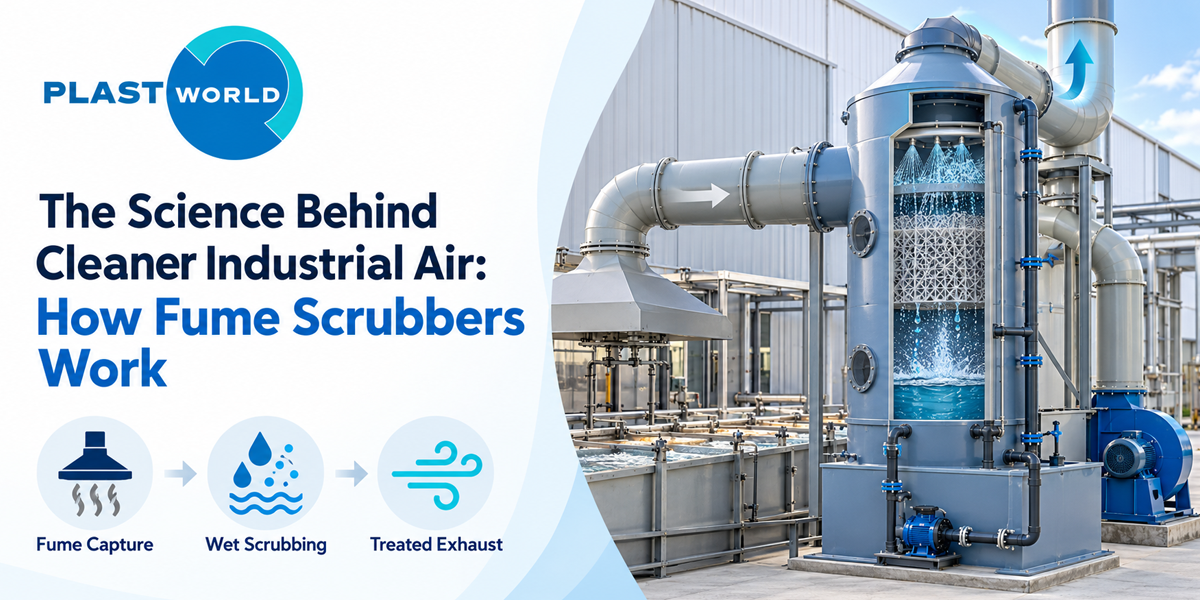
Industrial activities include processes that generate fumes using acids, chemicals, hot metal, or surface treatment methods. Pickling operations may, for instance, use hydrochloric acid, sulphuric acid, nitric acid, hydrofluoric acid, or combination of acids. It should be possible to effectively extract and treat such fumes in order to avoid build-up in the vicinity of production sites.
Simply moving contaminated air away from a process is not always enough. The extracted air may still contain corrosive or harmful substances. A properly designed scrubbing system combines extraction with treatment, helping remove contaminants from the exhaust stream before the treated air is discharged.
This concept works on simple principles; air that is contaminated is drawn from the point of origin, taken through the duct work to the point of treatment.
The process generally begins with fume capture. Hoods, enclosures, lateral suction ducts, or other extraction arrangements are positioned close to the emission source. A fan creates the required airflow to draw fumes away from the process area.
The contaminated air then travels through corrosion-resistant ducting toward the scrubbing unit. Inside the scrubber, the gas comes into contact with a suitable scrubbing medium. Depending on the process and pollutants involved, the system can facilitate absorption, neutralization, or removal of contaminants from the air stream.
After treatment, cleaner exhaust air can be discharged through the appropriate outlet or chimney. The exact design depends on factors such as the type of fumes, concentration, airflow, process conditions, and required emission control.
Wet scrubbing is widely used for controlling gases and fumes because the scrubbing liquid can interact with soluble or reactive contaminants. As contaminated air passes through the scrubber, contact between the gas and liquid promotes the transfer of targeted pollutants into the liquid phase.
When it comes to the corrosive industrial fumes, the choice of the materials becomes crucial. Plast World manufactures corrosion-resistant systems for the fume extraction and scrubbing made of thermoplastics.
The scrubbing process can therefore do more than simply collect fumes. It can help transform the exhaust stream into a more controlled and treated discharge, depending on the system configuration and process requirements.
An effective system needs to begin at the point where fumes are generated. Poorly positioned extraction points can allow contaminants to spread through the workplace before they are captured.
Plast World offers different extraction arrangements, including full enclosure and lip-type lateral suction ducting for specific industrial applications. Its zinc white fume extraction systems, for example, use lateral ducting around the zinc kettle to capture fumes generated during dipping and direct them toward the scrubbing unit.
This approach can help maintain cleaner production areas while reducing the exposure of surrounding structures and equipment to corrosive fumes. Effective fume control can also contribute to better visibility, improved workplace conditions, and reduced corrosion of nearby structures.
They are particularly useful in industries where chemical vapours and process fumes are generated during production. Common applications include:
Plast World manufactures and supplies extraction and scrubbing solutions for several of these applications, with systems designed according to the process requirements.
A scrubber cannot be treated as an isolated piece of equipment. Its performance depends on how well the complete system is designed, including the capture arrangement, ducting, fan, scrubber, discharge system, and process conditions.
The type of pollutant also influences the design. Acid fumes, zinc fumes, particulate matter, and other emissions may require different approaches to capture and treatment. Airflow requirements, chemical compatibility, operating temperature, and maintenance requirements should also be considered during system selection.
This is why working with a Plast World, a leading fume scrubber manufacturer can help industries develop a solution that is better aligned with their specific process rather than relying on a generic configuration.
Before selecting a system, industries should evaluate the source and characteristics of the fumes being generated. Important considerations include the type of chemical or material involved, emission volume, operating conditions, extraction points, airflow requirements, and applicable environmental requirements.
Material compatibility is equally important, particularly in applications involving aggressive chemicals. Plast World specializes in thermoplastic process equipment and manufactures extraction systems designed for demanding metal finishing environments. The company also provides planning, equipment supply, erection supervision, start-up support, operating guidance, and technical assistance for relevant systems.
Industrial air quality is closely connected to how effectively fumes are captured and treated at their source. A well-designed scrubbing system can help industries control corrosive emissions, protect equipment, improve workplace conditions, and support responsible exhaust management.
With its experience in thermoplastic process equipment and industrial fume extraction, Plast World provides solutions for applications ranging from pickling and galvanizing to electroplating and anodizing. Its focus on process-specific design and corrosion-resistant construction makes fume control an important part of its industrial equipment portfolio.
A wet scrubber brings contaminated air into contact with a suitable liquid medium. Depending on the pollutant, the process can absorb or neutralize contaminants from the air stream.
They are typically used in pickling, galvanization, electroplating, anodization, metal finishing, surface treatment, and similar industries where there will be chemical fumes or vapors produced.
Industrial fumes can be very corrosive. Therefore, using proper material with corrosion resistance will be helpful in operating the equipment.

Plast World
Plot NO. 07, Dev Estate,
Nr. National Rifle, Opp. Power House,
Ramol Cross Road, Vatva,
Ahmedabad- 382 445
Gujarat (india)
Powered by : #1 Vinayak InfoSoft - SEO Company Ahmedabad All Copyrights © . Plast World
