

 By Admin
  August 31, 2026
Strength is what makes steel valuable, but when left alone, it begins to rust, which tends to move around. Rusting not only breaks down joints but also destroys the entire structure meant to last for years. This is where the galvanizing plant comes into play by putting zinc onto the steel.
It seems like an easy thing to do: dip the metal into the zinc, take it out, and you are done. However, it is a chain of tanks, temperature, and timings that have to be just right each and every time. If one misses something, the whole process fails.
That's where the right equipment matters. Plast World builds galvanizing plants that handle each of these stages reliably, which is a big reason we're known as a trusted Galvanizing Plant Manufacturer, Supplier, & Exporter in India.
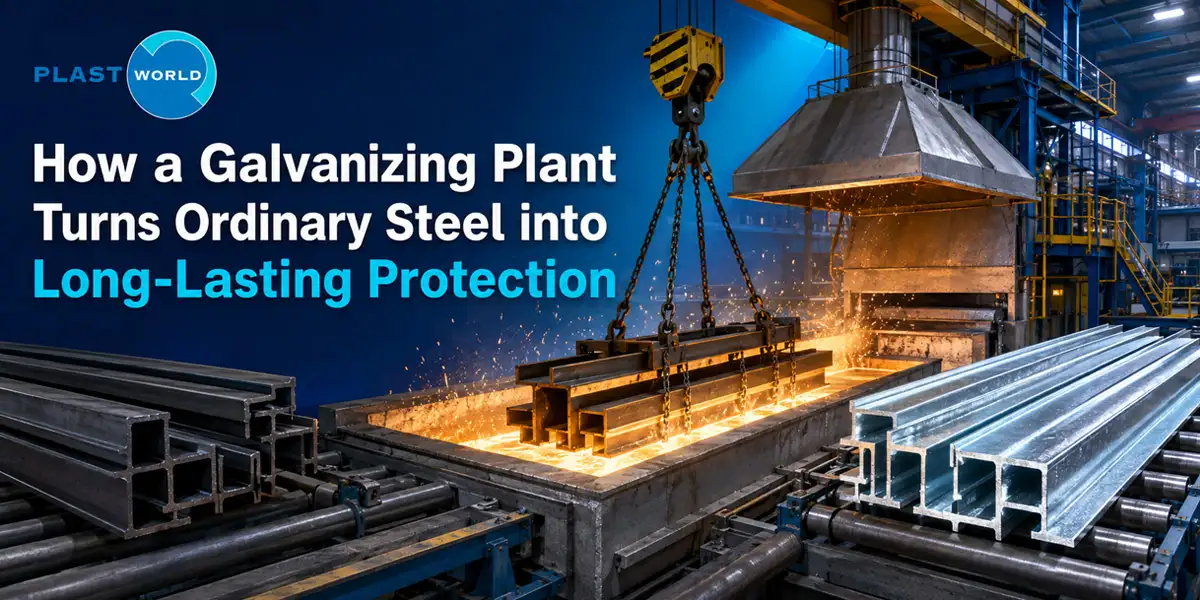
The corrosion process in bare steel begins from the very first minute of exposure to water and air. Left untreated, a structural beam or a fence post can lose meaningful strength within a few years, especially near coastal air or industrial pollution. Zinc coating changes that equation. Corrosion happens much less in zinc compared to steel, and even if the coating gets scratched, the zinc continues to provide protection for the steel in its vicinity. That's what distinguishes an infrastructure project that will need to be replaced in ten years from another that will stand firm for fifty years.
A galvanizing plant is not simply a zinc bath. It is a complete processing system in which each stage contributes to the quality of the final galvanized product.
The process generally begins with surface preparation and continues through several carefully controlled stages.
Steel surfaces need to be cleaned before they have to undergo the process of being coated with zinc.
Any contamination by oil, dirt, grease, and other materials may interfere with the process of galvanization. Cleaning agents are needed to clean the steel surface before other processing takes place.
Cleaning is essential because even minor contamination could alter the quality of the coating.
Even after cleaning, there may be rust or oxide on the surface of steel. Pickling is used to remove this by immersing the metal into acid.
This step exposes a cleaner steel surface and prepares it for the subsequent fluxing stage.
The quality of pickling directly influences the ability of zinc to react with the steel surface during galvanizing.
After pickling, the steel passes through a flux solution. Fluxing helps prevent oxidation of the prepared steel surface before it enters the molten zinc bath.
It also supports the formation of a clean interface between the steel and molten zinc.
Proper control of the flux solution is therefore an important part of maintaining consistent galvanizing quality.
This is the stage most people associate with hot dip galvanizing.
The prepared steel component is immersed in a bath of molten zinc maintained at a controlled temperature. When the steel comes into contact with the molten zinc, metallurgical reactions take place between iron and zinc.
This results in the formation of a series of layers of iron-zinc alloy, with the outside layer made of zinc. These layers make up the protective coating.
After this process is completed, the component is withdrawn from the zinc bath. The amount and appearance of the coating depend on factors such as steel composition, immersion conditions, bath temperature, withdrawal speed, and surface preparation.
After leaving the zinc bath, galvanized components are cooled and allowed to stabilize. Depending on the product and process requirements, additional handling or finishing operations may follow.
Inspection is another important stage. The galvanized surface can be tested in terms of appearance, coating thickness, and adhesion among other criteria.
This will ensure that the final product meets the required standards before being taken to the warehouse.
Plast World provides industrial solutions associated with surface treatment and galvanizing requirements. Through its expertise in pickling and galvanizing-related equipment, the company supports industries looking for practical solutions for corrosion protection processes.
For businesses planning a new galvanizing facility or improving an existing setup, selecting equipment based on actual production requirements can make a significant difference to process efficiency and coating quality.
Galvanizing isn't a finishing touch. It is what decides whether steel survives its environment or fails early. Every stage in the plant, from cleaning through the zinc bath to final inspection, has to work in sequence for the coating to hold.
That's why choosing the right plant builder matters as much as the process itself. Plast World has spent years refining tank design, kettle performance, and process controls, which is why manufacturers across India and abroad turn to us as their Galvanizing Plant Manufacturer, Supplier, & Exporter in India.
A galvanized coating can last up to 30 to 70+ years depending upon environmental conditions before the coating needs recoating.
Hot dip galvanization is done by dipping the metal in molten zinc to create a metallurgical coating, but electroplating uses electricity to deposit a coating of zinc.
Galvanized steel is weldable and paintable. Welding should be done under ventilation to prevent zinc fumes, and painting requires correct preparation of surfaces.

Plast World
Plot NO. 07, Dev Estate,
Nr. National Rifle, Opp. Power House,
Ramol Cross Road, Vatva,
Ahmedabad- 382 445
Gujarat (india)
Powered by : #1 Vinayak InfoSoft - SEO Company Ahmedabad All Copyrights © . Plast World
