

 By Admin
  July 02, 2026
Chemical processing plants deal with highly corrosive acids, hazardous chemicals, and demanding operating conditions every day. From metal pickling and surface treatment to chemical storage and industrial cleaning, safety remains the top priority. The equipment used to handle aggressive chemicals plays a crucial role in preventing accidents, minimizing downtime, and ensuring regulatory compliance.
This is where FRP pickling tanks have become the preferred choice across industries. FRP Pickling Tanks, compared to conventional steel or concrete tanks, have outstanding anti-corrosive properties, strength, and durability, which makes them very suitable for environments where there are chemicals.
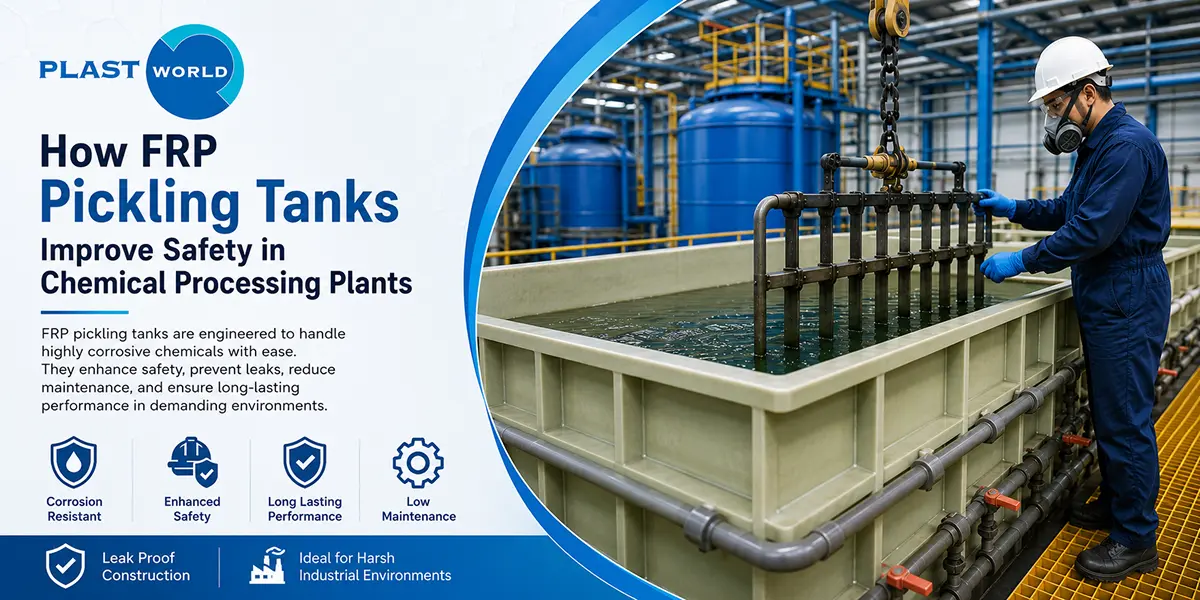
FRP Pickling Tank is an acid resistant industrial tank which uses Fiber Reinforced Plastic as its construction material and is specifically designed for storage of or processing of chemicals in pickling operation.
Pickling is commonly used to remove:
There are strict safety guidelines for chemical processing plants as they process hazardous materials and these materials may cause:
Poor quality tanks can be the weak link in the entire process, resulting in significant losses and incidents due to corrosion, leaks, or tank failure.
The most significant thing about the tanks is that they possess better corrosion resistance capability.
Unlike the mild steel tanks which rust, corrode, and degrade upon exposure to acids, FRP tanks do not exhibit such behaviours.
Benefits include:
This makes FRP ideal for industries where acids are used continuously.
FRP tanks are compatible with numerous industrial chemicals.
These include:
An experienced FRP pickling tank manufacturer carefully selects the appropriate resin system according to the chemical being processed.
Although lightweight, FRP tanks possess impressive mechanical strength.
They can withstand:
Their strength ensures safe operations even under tough environments.
Metal tanks gradually weaken due to corrosion, leading to:
FRP tanks eliminate these common issues. Since the material itself is corrosion-resistant, the likelihood of unexpected tank failure is greatly reduced.
Regular maintenance raises both the operating cost and exposure of the employees to dangerous chemicals.
FRP tanks require minimal maintenance because they:
Reduced maintenance means fewer shutdowns and safer maintenance activities.
Industries require machines that can generate value over time.
High-quality FRP pickling tanks often last for decades with proper maintenance.
Their durability reduces:
FRP pickling tanks are widely used in:
These industries depend on corrosion-resistant equipment for safe chemical handling.
Safety is the backbone of any thriving chemical processing plant. As aggressive acids and corrosive chemicals are used in many industrial processes, it is important to have the proper equipment for the purpose. The FRP pickling tanks are known to provide excellent corrosion resistance, being completely leak proof, extremely durable, and having minimum requirements for maintenance – thus ensuring maximum safety.
Collaborating with Plast World , a reliable FRP pickling tank manufacturer, businesses minimize their risks and increase worker's safety and equipment life span, as well as ensure continuous production process.
An FRP pickling tank is a highly durable and corrosion-resistant tank that is made using Fiber Reinforced Plastic and which is designed to safely hold acidic fluids in chemical reactions and pickling processes.
FRP pickling tanks have a better anti-corrosion capability, longer life, less maintenance, and better safety performance than traditional steel tanks.
Yes. They are also leak-proof, which minimises any risks of chemical spills and keeps soil and water safe from contamination, enabling environmentally responsible operating.

Plast World
Plot NO. 07, Dev Estate,
Nr. National Rifle, Opp. Power House,
Ramol Cross Road, Vatva,
Ahmedabad- 382 445
Gujarat (india)
Powered by : #1 Vinayak InfoSoft - SEO Company Ahmedabad All Copyrights © . Plast World
